5 Tools That Make PR Pros More Effective
5 Tools That Make PR Pros More Effective
PR Tips ·
PR поради ·
October 2025
October 2025

PR specialists spend a lot of time managing — contacts, channels, formats, relationships. But managing without a system is just organized chaos. These five tools, borrowed from marketing, bring structure to the work and make it measurably more effective.
Marketing tools that make PR work smarter
PR specialists spend a lot of time managing — contacts, channels, formats, relationships. But managing without a system is just organized chaos. These five tools, borrowed from marketing, bring structure to the work and make it measurably more effective.
1. Contact types
Not all contacts are equal, and treating them as if they are wastes your best energy on your least productive relationships.
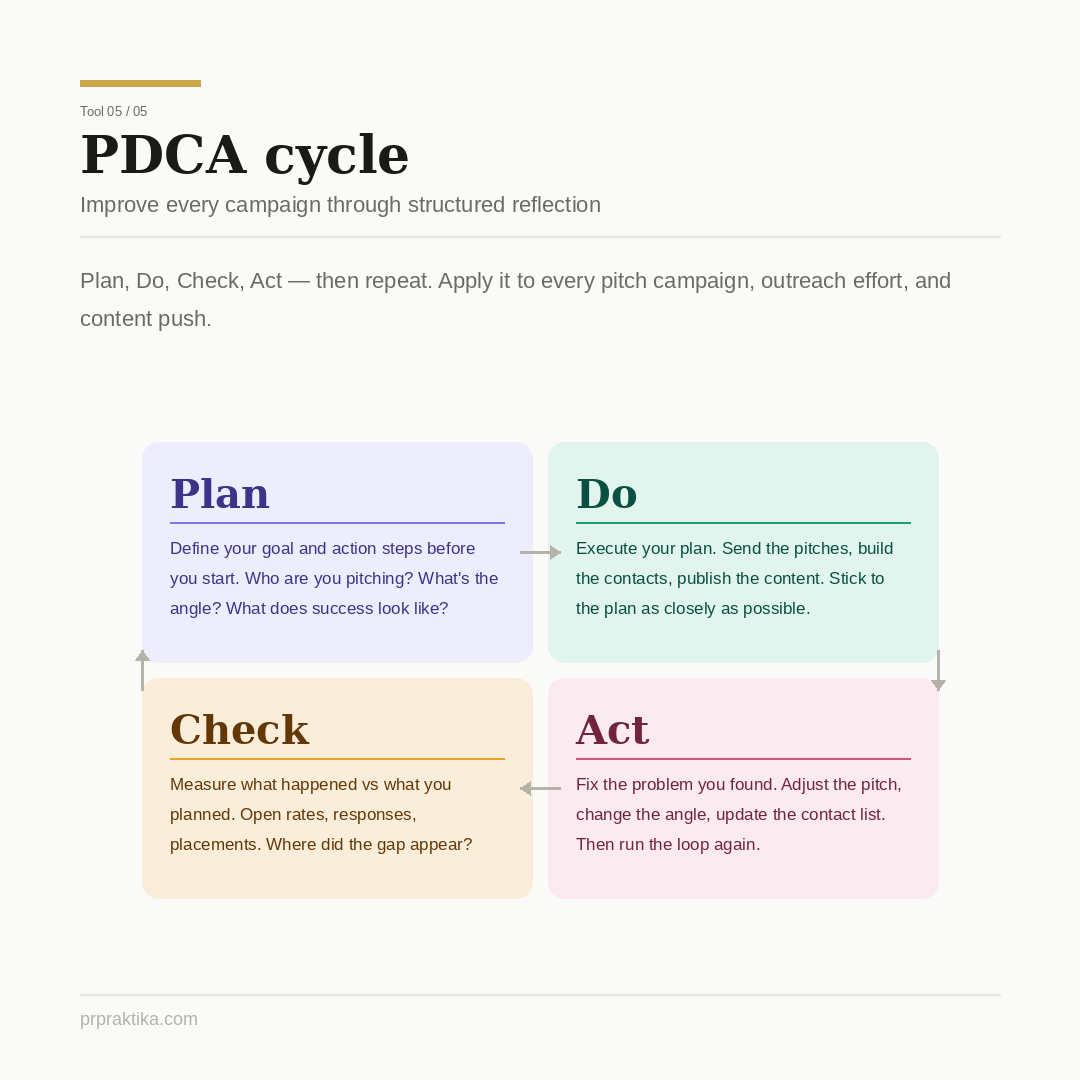
Evaluate every contact in your base on two criteria: manageability (can you generate coverage with them when you need it?) and impact (is the placement actually worth having?). The result is four types: high-impact and manageable — your priority partners; high-impact but unmanageable — worth nurturing; low-impact but manageable — useful for volume; low-impact and unmanageable — remove them from your base entirely. This simple sorting tells you where to focus, who to invest in, and who to let go.
2. BCG matrix
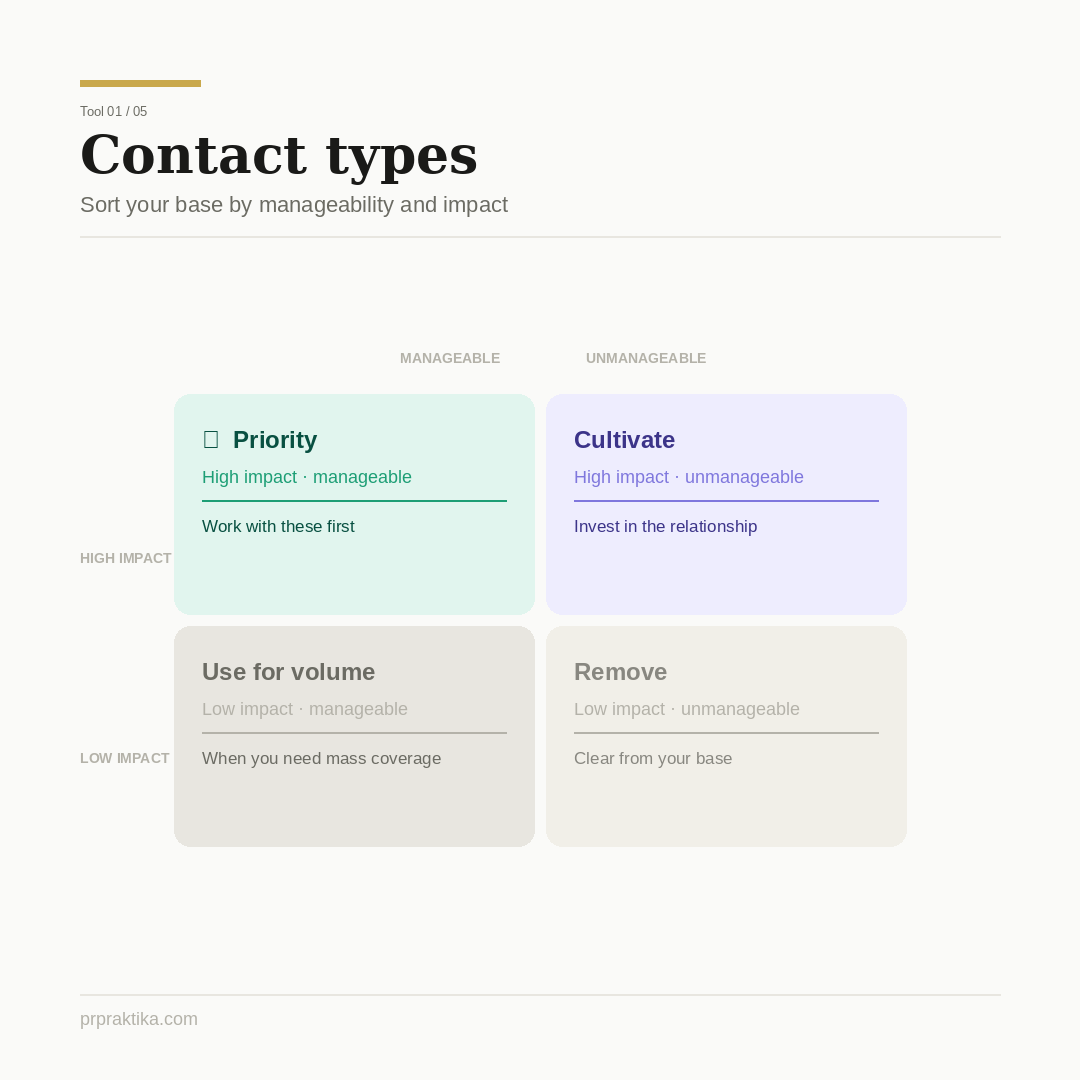
Originally a business strategy tool, the BCG matrix maps your media channels against two axes: effort and result.
Stars require effort but already deliver. Cows are your steadiest, most reliable placements — protect them. Problem children take a lot from you and haven't paid off yet, but might. Dogs take everything and give nothing — delete them. When you see your channels laid out this way, resource allocation becomes obvious.
3. Contact warmth matrix
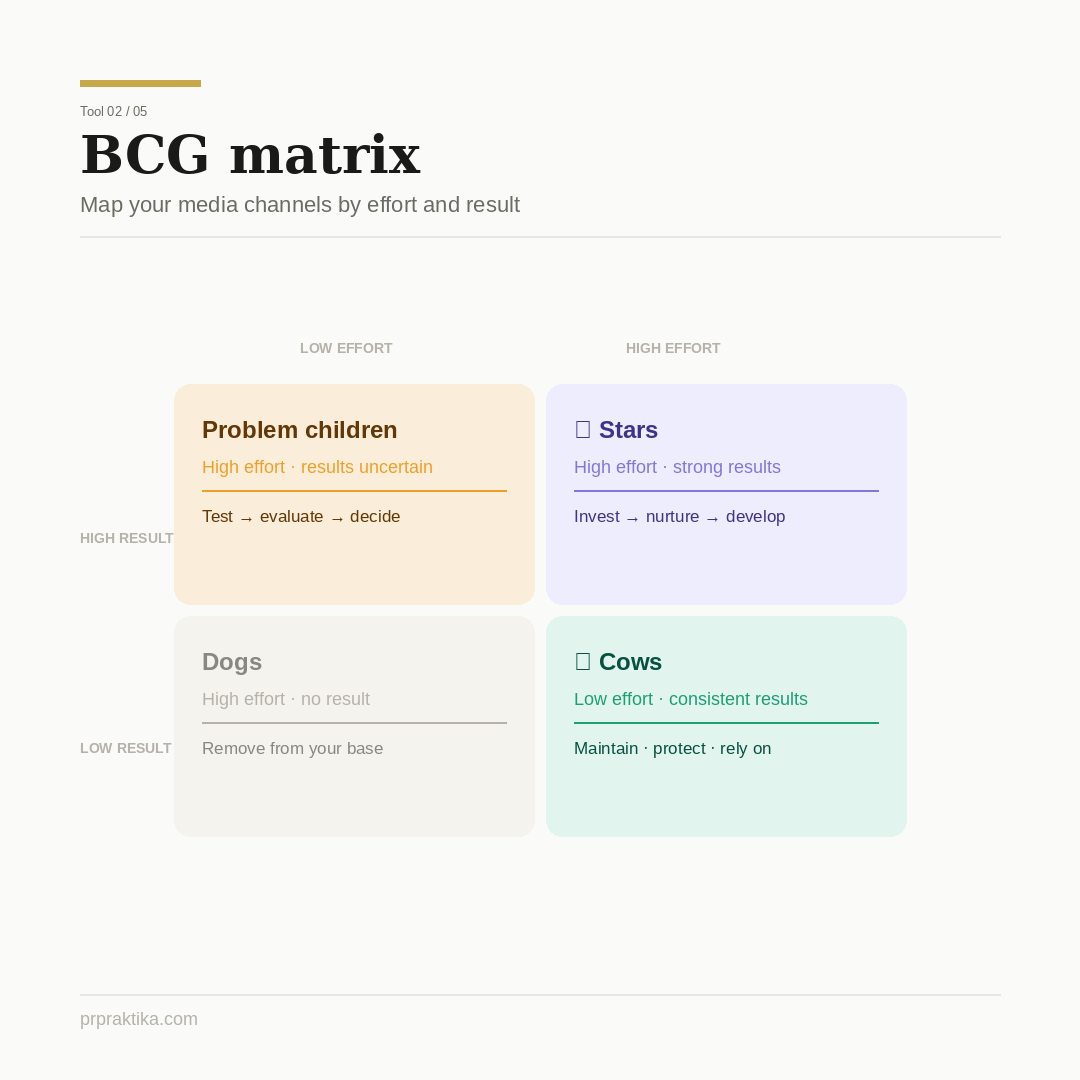
This combines the first two tools into a dynamic picture of your relationships over time.
Plot your contacts on a grid: BCG categories on one axis, contact types on the other. Your goal is to move partners diagonally — from unmanageable or low-impact toward manageable and high-impact. If a journalist who never responded is now pitching you story ideas, that's warmth increasing. Track it. A monthly or quarterly update shows you exactly where your relationship-building is working and where it isn't.
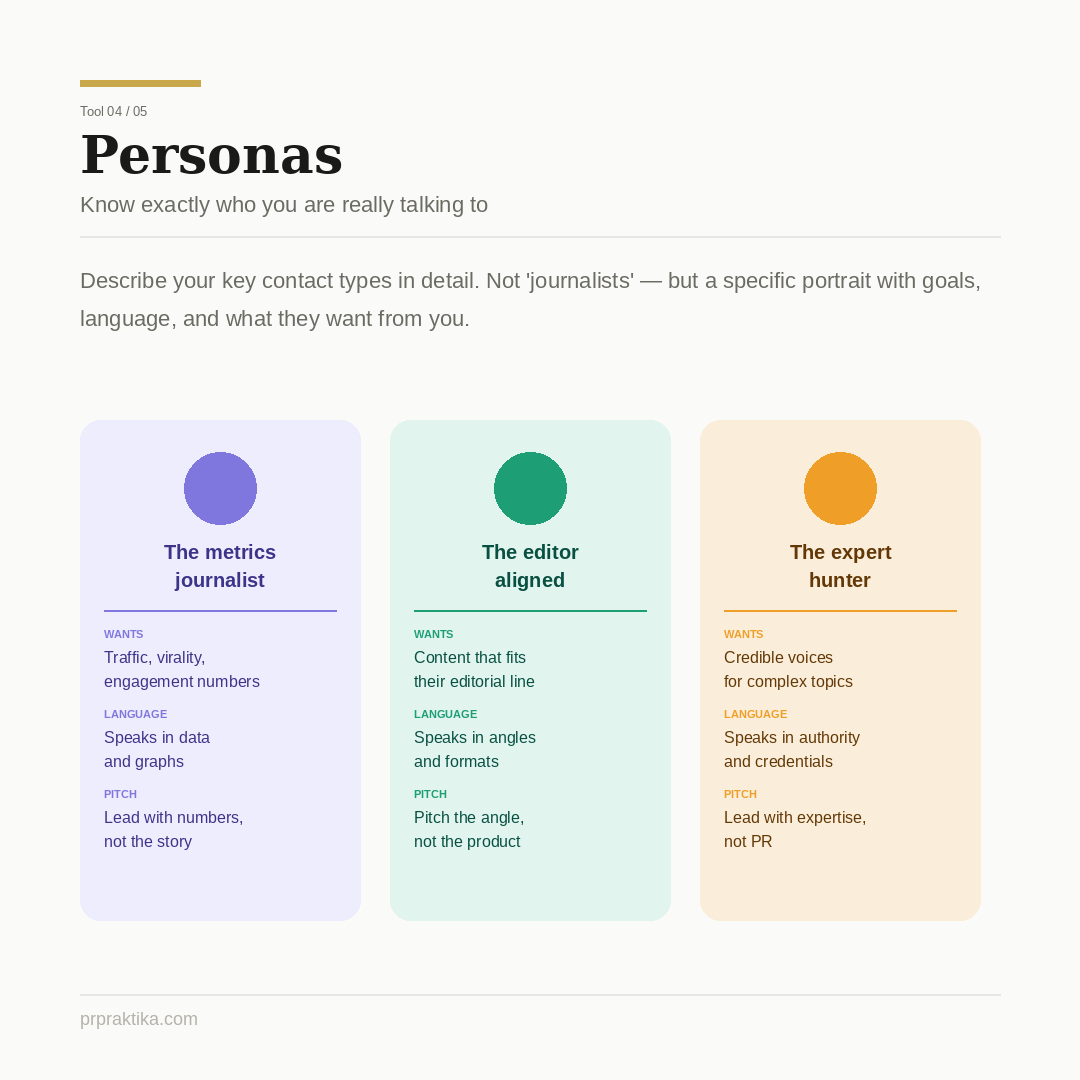
4. Personas
Your target audience as a PR specialist isn't "journalists." That's too broad to be useful.
Describe the specific types of people you work with — their goals, their incentives, how they prefer to communicate, what formats they respond to. One useful persona: the metrics-driven journalist. They're not interested in your product; they're interested in what working with you will do for their traffic numbers. Pitch them in their language — data, reach, virality potential. The right persona description changes how you write every email.
5. PDCA cycle
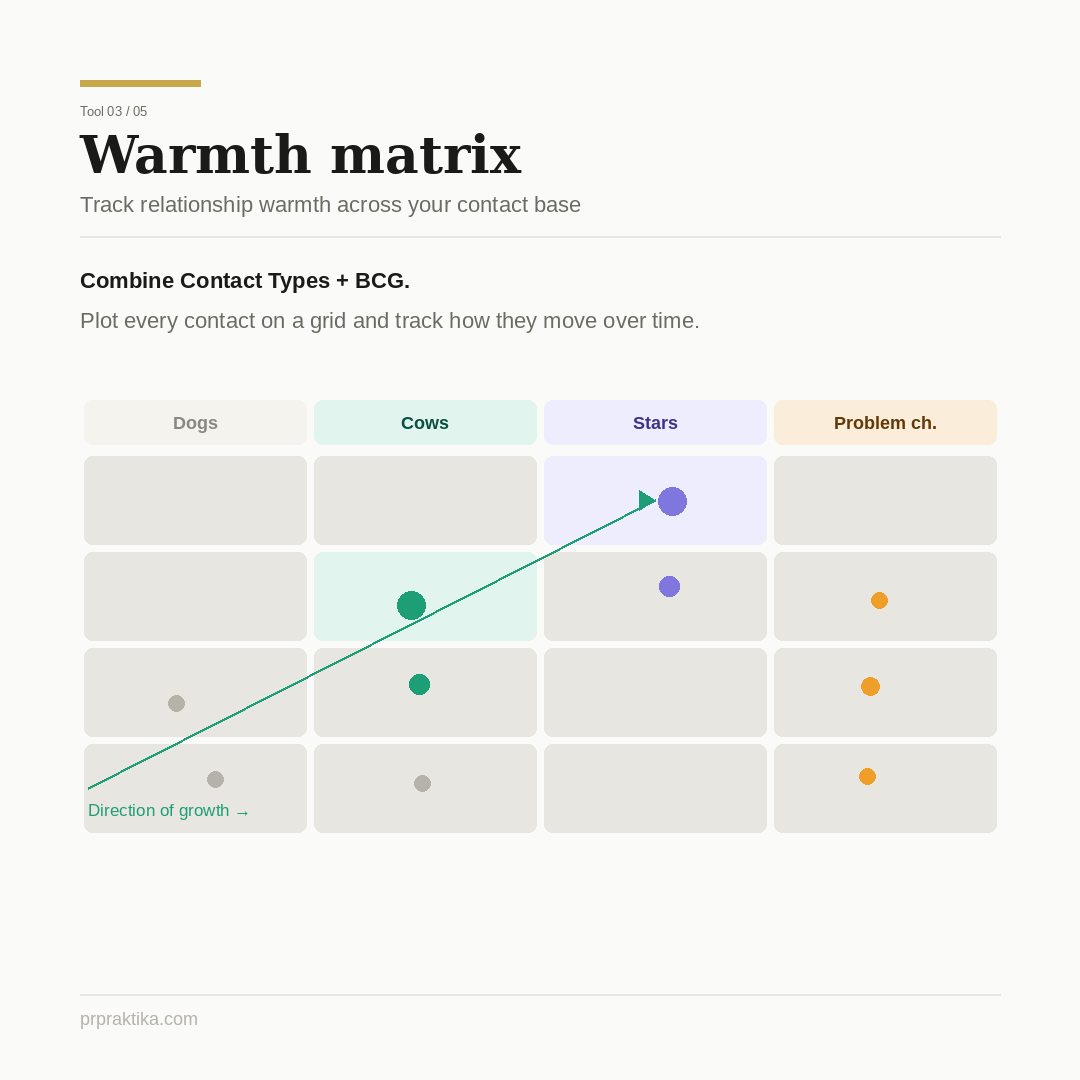
Plan, Do, Check, Act. A loop designed for continuous improvement rather than one-off efforts.
You send 100 pitches and hear back from 10. Instead of moving on, you stop and ask why. Was the subject line weak? Was the angle irrelevant? Was the timing off? You find the issue, fix it, and run the cycle again. Applied consistently, this approach turns each campaign into a learning system rather than a series of isolated attempts.